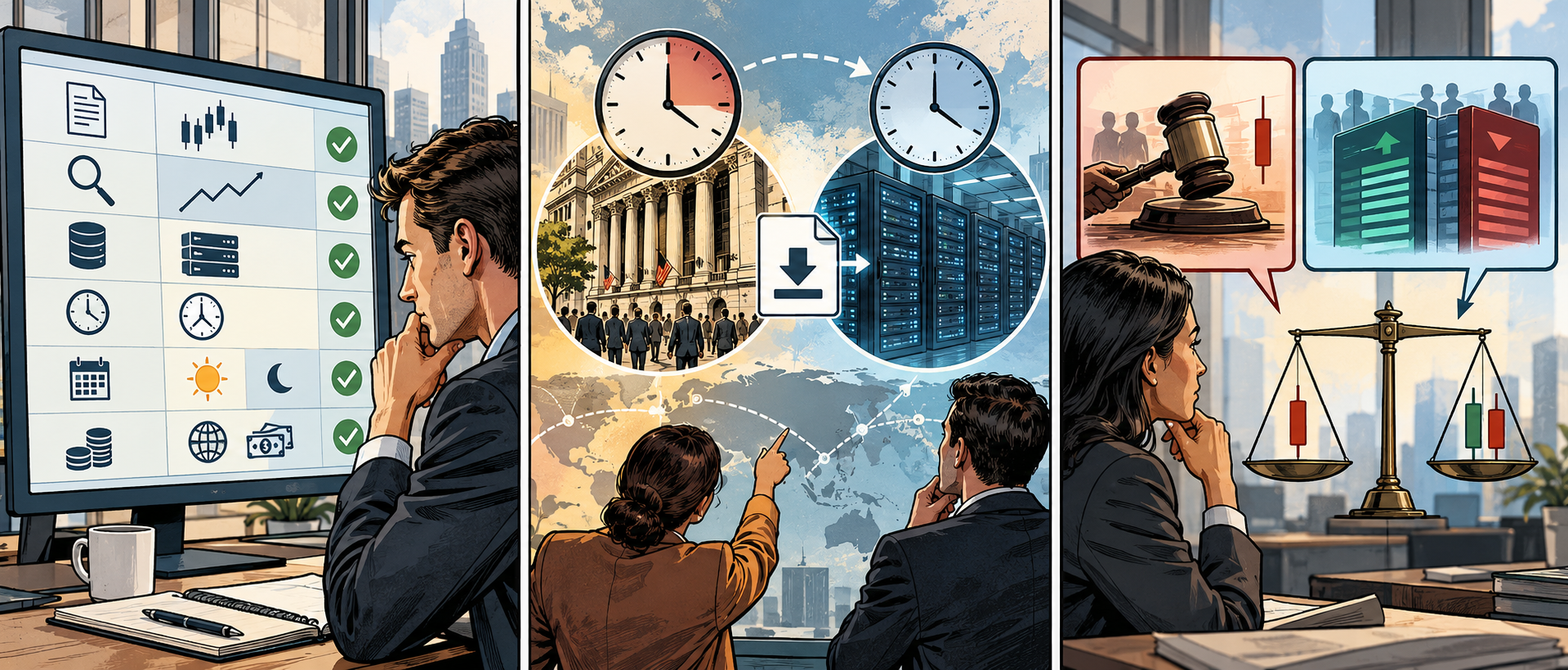
Which timestamp establishes freshness?
Keep track of the times the source monitored the market and when your system obtained the data. A file download at 10:05 does not change the last trade timestamp of 09:20 to a 10:05 observation. Store either the timezone or an obvious offset. If the provider does not provide a monitoring time, state this restriction as opposed to creating a monitoring time based on when the web request was finished.
Why can two correct fields show different values?
Trade records a purchase or sale at the terms specified; Bid and Ask refer to existing quotes from the feed's perspective. There is no guarantee that an order will be executed at the last price paid. Additionally, variations may occur due to differing session types and market coverage. Official order-types and extended-hours bulletins further distinguish between the two, while actual freshness restrictions must be documented in the specific feed's documentation.
What does an original validation example show?
Suppose a hypothetical record was received at 14:03 UTC. The most recent trade for this record took place at 13:40 UTC. The price per share was $50. Another record shows the bid and ask prices were $49.90 and $50.10 respectively as of 14:02 UTC. The time elapsed since the retrieval of the first record (14:03 UTC) and its last trade (13:40 UTC) was 23 minutes. The bid–ask midpoint for the second record is $50. Both records contain accurate information. Therefore, if the first record were labeled "live at 14:03," it would inaccurately describe what actually occurred.
[Table]
Check | Example response
Missing observation timestamp | Mark freshness unknown
Missing price | Preserve null and suppress calculated return
Bid above ask | Flag for investigation under feed conventions
Unknown currency | Do not combine with another price series
Different session | Display the session alongside the value
[End table]
How should a stale record be displayed?
Show when the data was actually observed and whether the data is available at this point (or if there is a delay). Don't just continue to use the same data as a new price forever. The system should be able to keep the old data for auditing purposes but hide the current data from being compared against other instruments. Freshness rules should be set for each field and session; instead of setting one freshness rule for all feeds or instruments.
Should conflicting values be averaged?
Not before establishing equivalence. Creating a value from the average of the prior close, extended hours trade, and the current ask produces a value that does not represent a true market price. Maintain all data points, along with where they came from (provenance) and research potential issues related to security identification, adjustment methods, and how the various fields are defined. A source-priority policy should explain why a particular record was chosen over another record that also represents the same security.
What should a publication disclose?
State if the page is currently connected to a live licensed feed, delayed observations or not connected. The purpose of this educationally focused article is to provide no real-time quotation. While the worksheet associated with the article may assist in identifying inaccurately labeled data, passing the validation process does not confer rights to redistribute the data nor does it ensure that an order will be filled at the price shown. Data accuracy, acceptable uses of the data and potential results from trading on the data are separate issues.
The length of time that has passed since a trade was last executed on a security (trading halt) or a security was removed from active trading (inactive instrument) is not sufficient to describe why there have been no recent trades. You should check the current status of the security, as well as how your feed handles those types of events, instead of creating imaginary trades to make the security appear to be traded continuously.
What other questions do readers ask?
Does a fresh page refresh mean the price is current?
No. Check when the underlying data was last updated, in addition to when you retrieved it or when the web page refreshed.
Should a missing price be stored as zero?
Zero can result in inaccurate calculations and therefore cannot replace missing data.
Can last trade and ask both be correct while different?
Yes. Each represents a different field and each could potentially represent a different time or situation.
What are the limitations of this guide?
This is a draft version of an educational research document for review by individuals. The content of this document is intended to be general in nature and does not contain personalized advice or assurances regarding the outcome. Prior to the publishing of any portion of this document, reference materials must be verified as being relevant to the specific claim made. Hypothetical examples are not issuer data.